Kashgar Surveillance, Fewer Checkpoints on the Street and Cameras, Apps and Informants Everywhere Else
In 2018 a walk across central Kashgar meant a police post every hundred metres or so. They were called convenience police stations, and Xinjiang built thousands of them after Chen Quanguo arrived from Tibet as party chief in August 2016. Some street corners had ten cameras. Uyghurs on buses were taken off at checkpoints for ID checks and body scans while Han passengers stayed in their seats.
Go now and much of that has gone quiet. AP reporters in 2021 found many checkpoints and police stations in Kashgar taken down and the sirens that once filled the city gone. AFP in 2023 saw only a handful of officers and old scanners left unused on the pavement.
Beijing would like you to read that as the end of something. It's the opposite. The system no longer needs as many people on the street because it's in the phones, the cameras and the homes.
An app that decides who's suspicious
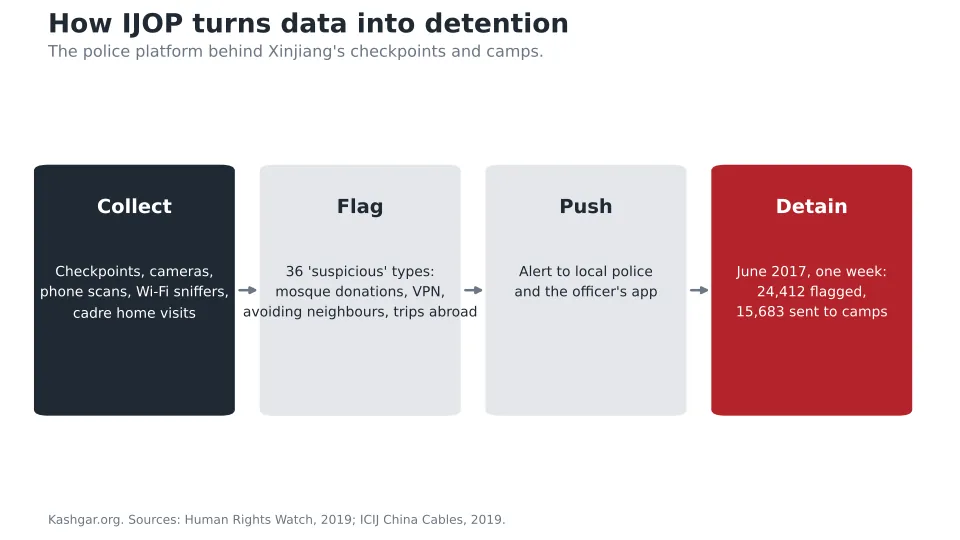
The core is the Integrated Joint Operations Platform. Human Rights Watch got hold of the police app linked to it in 2018 and took it apart. Officers used it to log 36 types of "suspicious" people. They included people who stopped using their smartphones, people who avoided their neighbours, people who'd been abroad too long, and people who'd collected money for a mosque "with enthusiasm". Using WhatsApp, Telegram or a VPN was a flag. So was buying fuel for a car registered to someone else. Checkpoints acted as virtual fences, checking each person's status as they passed.
The system was predictive and it fed the camps. The China Cables showed IJOP flagging 24,412 people in southern Xinjiang in one week of June 2017. Most of them were sent away.
Residents had to put spyware on their own phones. Jingwang Weishi, an app from a Shanghai firm, scanned files against a government blacklist and reported back. Officials went door to door to check it was installed. Travellers crossing into Xinjiang by land had a separate app put on their phones at the border that copied texts and contacts and checked files against a list of tens of thousands of items.
Blood, DNA and a cadre in the spare room
In 2017 the region ran a campaign it called "Physicals for All". Everyone between 12 and 65 gave DNA, blood type, iris scans and fingerprints. A Kashgar resident told Human Rights Watch that his neighbourhood committee made attendance compulsory and that refusing would have marked him as having a "thought problem". State media put participation at 18.8 million.
Then the state moved in. Under a programme called "Pair Up and Become Family", more than a million cadres were assigned to Uyghur households by late 2018. They stayed for days at a time, ate with the family and reported back on it. A Kashgar baker was quoted in People's Daily praising the officials living in his home. What else could he say?
The visiting rules still bite. In 2024 Radio Free Asia reported a couple in a Kashgar county held overnight at a village police station for not reporting a relative who came to stay. The deadline to register a guest can be as short as ten minutes.
Built by companies the West banned
The cameras have brand names. Hikvision and Dahua, China's two biggest surveillance firms, won more than $1.2 billion in Xinjiang security contracts after 2016, according to the research firm IPVM. In one Hotan county, a Hikvision project put face-recognition cameras at the entrance of all 967 mosques. The US put both companies on its Entity List in October 2019, together with Xinjiang's public security bureau, and in 2022 the FCC banned new authorisations for their equipment.
Beijing says all this is counterterrorism and that it worked, since there have been no attacks in years. Ask what a counterterrorism system needs with a database of who prays, a cadre in the family's spare room and the iris scans of every twelve-year-old.
The checkpoints came down because the cameras went up.