Id Kah Mosque in Kashgar, China's Biggest Mosque Turned Into a Ticketed Stage Set
Id Kah is the mosque on every Kashgar postcard. Yellow brick, a tiled gateway, two slim minarets about 18 metres high, and a courtyard of poplars behind. It was founded in 1442, the present building dates mostly from 1798, and it covers about 16,800 square metres. On the big festivals it once held around 20,000 people at prayer, with the crowd spilling into the square outside.
Today you buy a ticket to go in.
That's the short history of Islam in Kashgar since 2016, told in one building. The mosque still stands, still looks the part, and is still shown to every foreign delegation Beijing brings to Xinjiang. What went missing were the worshippers.

Photo: Radosław Botev, CC BY 3.0 pl, via Wikimedia Commons

Ten thousand, then nine hundred, then nobody
The attendance figures tell it plainly. Friday prayers at Id Kah drew about 10,000 men in 2009. By 2011 it was four to five thousand. By 2021 it was eight or nine hundred, and the imam put that down to "a natural shift in values". When AFP reporters visited in 2023 they counted no more than two dozen men at Friday prayers.
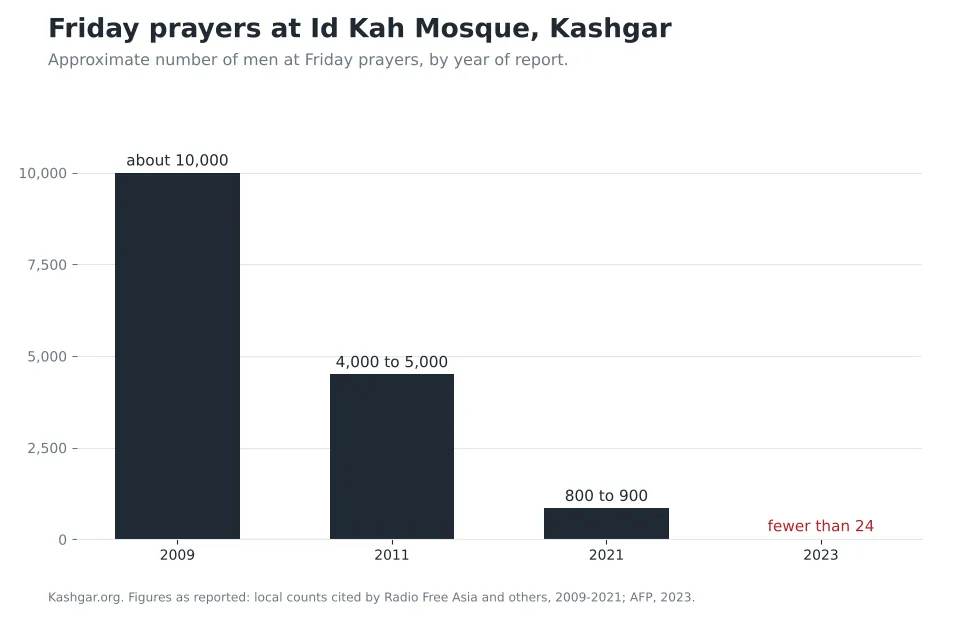
Radio Free Asia called the mosque in 2023 and spoke to a local police officer. He said nobody was allowed to pray there because the mosque now sells tickets, and that it had been like that for five or six years. Tickets run 20 to 40 yuan. People over 65 go in free. Footage posted between 2011 and 2016 shows thousands praying in the courtyard. Footage from 2019 shows an empty prayer hall.
The imam, Memet Jume, told the UN human rights chief Michelle Bachelet in May 2022 that Id Kah was open for normal worship. The police officer on the phone told a different story. Only one of them was speaking on a tightly managed official visit, with minders listening.
The symbols came down first
In 2018 the plaque over the entrance came off. It carried a Quranic inscription dated to 1908. The star-and-crescent finials on the dome and minarets were taken down too, according to Radio Free Asia, and hadn't returned by 2020. A rights researcher described a mosque being stripped of its religious meaning to become a shell for visitors.
Out front, the square was cleared around 2000 for a concrete plaza and shops. A big screen now faces the mosque. It shows Xi Jinping.
The imam before Memet Jume was Juma Tayir, a government appointee who sat in the National People's Congress and preached loyalty to the party. On 30 July 2014 he was stabbed to death outside the mosque after dawn prayer. The killing was a crime and his attackers were tried. Beijing used it as one more reason to tighten its grip on the mosque, and his successor was later jailed for fifteen years on extremism charges.
Spared for the cameras
Here's the uncomfortable part. Across Xinjiang, the Australian Strategic Policy Institute estimated in 2020 that about 16,000 mosques, some 65 per cent, had been destroyed or damaged since 2017. Kashgar's city centre came out better than most. Its showcase mosques mostly still stand.
That isn't mercy. A Kashgar religious affairs official told Radio Free Asia in 2016 that about 70 per cent of the city's mosques had already been demolished in a "rectification" campaign because some were "unnecessary". Out in the prefecture, the Kargilik Grand Mosque was flattened in 2018 and the desert shrine at Ordam Mazar was erased. What survived in the centre survived because tourists and diplomats come to see it.
Beijing's answer is that Xinjiang still has about 24,000 mosques and that freedom of religion is protected by law. Go to Id Kah on a Friday and count.
The building is fine. The mosque is gone.