Kashgar Special Economic Zone, Sixteen Years After Beijing Promised a Shenzhen of the West
In May 2010, a year after the Urumqi riots, Beijing decided Xinjiang's problem was poverty and that money would fix it. A central work conference approved a special economic zone at Kashgar, the country's sixth. Fifty square kilometres, ten of them out at the Irkeshtam border post. Five years without income tax for new firms, cheap land, subsidies. A banner under the Mao statue in the city centre read "Learn from Shenzhen, pay tribute to Shenzhen".
The pitch was explicit. Kashgar would do what Shenzhen did in the 1980s, turn from a backwater into a manufacturing and trading hub, this time facing Central Asia. A Chinese economist told the Los Angeles Times the gap between east and west would be closed by 2020.
It wasn't.
The skyline that stopped halfway
Shenzhen became Kashgar's official partner city in the aid programme that pairs rich provinces with poor parts of Xinjiang. Since 2010 it has sent 2,023 cadres and run more than a thousand projects. The plans were large. In 2013 visitors were shown a site for 280-metre twin towers with a Hilton and a duty-free mall for Prada and Louis Vuitton. The site was dust.
By 2017 the new satellite towns that Shenzhen and Guangzhou began building around Kashgar in 2012 and 2013 were stalled and half-built. A Shenzhen official called the prospects not bright. The reasons given were the security clampdown and the fact that the new districts had nothing to do with the Uyghur city next to them. Investors don't move to a place where every street has a police post and workers can vanish overnight.
The money that did arrive went partly into knocking down the Old City. Four provinces put an estimated 1.14 billion yuan into demolition and rebuilding there, moving mostly Uyghur families out of the centre.
What the numbers really show
Kashgar's economy did grow. By official figures the prefecture's GDP went from about 36 billion yuan in 2010 to 162.7 billion in 2024. In 2025 it reached about 175 billion, or roughly 38,000 yuan a head. That's still well under half the national average. A region of four and a half million people that was promised Shenzhen got a bigger version of a poor prefecture.
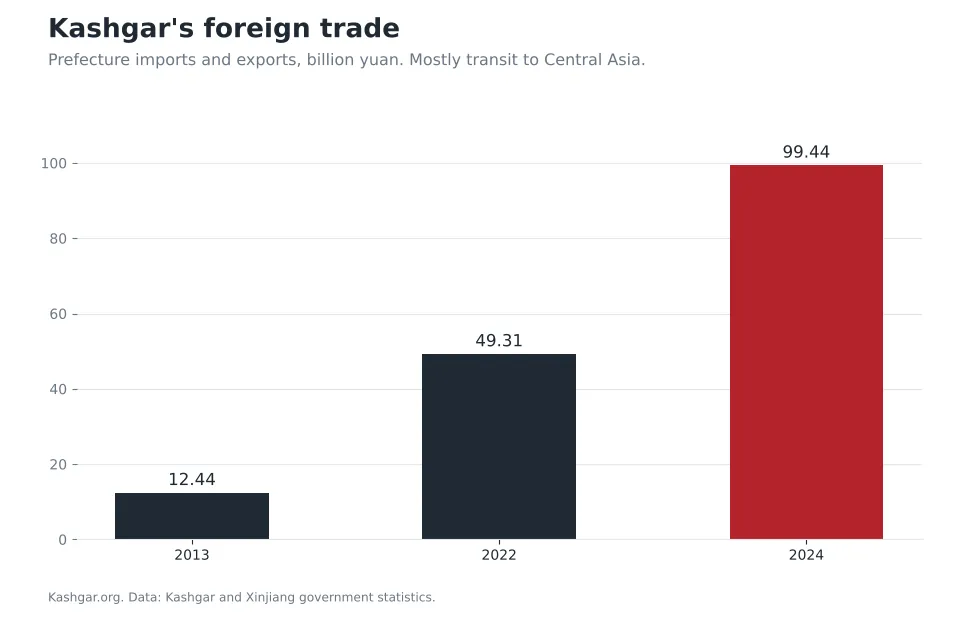
Trade is the one number that took off. Kashgar's foreign trade went from 12.4 billion yuan in 2013 to 99.4 billion in 2024, almost a quarter of Xinjiang's total. Irkeshtam handled about 2 million tonnes in 2024 and switched to 24-hour clearance in June 2025. Look closer and most of this is transit. Trucks carrying goods made in eastern China drive through Kashgar to Kyrgyzstan and Uzbekistan. The city gets the traffic and the paperwork. The factories are somewhere else.
The new plan sounds like the old one
In October 2023 Beijing announced a Xinjiang Pilot Free Trade Zone, and Kashgar got 28.48 square kilometres of it. Its stated focus is farm-product processing, textiles and electronics assembly. All three run on cheap labour.
That matters in Kashgar. The same years that the zone was being sold to investors, the prefecture was moving tens of thousands of rural Uyghurs into factory work under state labour-transfer programmes, many of them straight out of the camps. A 2018 Kashgar plan set a target of placing 100,000 camp "graduates" in jobs. Four Kashgar-prefecture companies now sit on the US forced-labour entity list, which bars their goods from America.
Officials report the free-trade area had 5,173 registered firms by 2025 and 93 billion yuan of trade. Ask what those firms make, who works the lines, and whether the workers could say no.
The Shenzhen of the west was a slogan. What Kashgar became was a checkpoint with a customs yard.